What turns a dance festival from a sequence of performances into a genuine shared experience? In his article “12 Reasons Why I Loved Moving Balkans 2026”, published in Springback Magazine on 31 July 2026, critic Dmitrijus Andrušanecas looks for the answer in the atmosphere, encounters and performances that shaped the second edition of the Moving Balkans Contemporary Dance Showcase in Novi Sad.
His “12 reasons” function less as a ranking and more as a gradually unfolding portrait of the festival — a place where performances matter, but where the conversations in between, coffee with artists, professional meetings and the feeling of being part of a shared process matter just as much.
A festival that leaves room for encounters
Andrušanecas begins with a familiar image: festivals can sometimes feel like airports, with everyone constantly rushing from one event to the next. Moving Balkans, in his account, creates almost the opposite sensation.
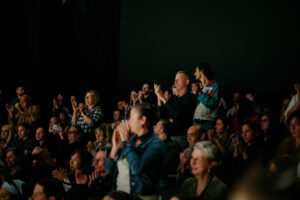
Although the programme unfolds across different locations in Novi Sad, SKCNS Fabrika gradually becomes its centre — a place to which artists and guests repeatedly return. Between performances, there is space for conversations, coffee, presentations, VR experiences and unexpected encounters.
It is precisely this rhythm that allows the author to experience the festival not as a competition between works, but as a shared space in which art can genuinely build bridges.
This quality is particularly significant for a platform such as Moving Balkans, whose mission is to connect professionals from across the region and create opportunities for future partnerships, mobility and the international presentation of Balkan artists.
Ten works and one shared question
In Springback’s reading, the ten works in the selection gradually begin to connect into a larger narrative. Although highly diverse in their artistic languages and stage strategies, many return to themes such as exhaustion, fear, endings, belonging, loneliness and survival.
In Somatic Freaks – The Proprioceptors Revolution by Vlad Benescu and Alexandra Mihaela Dancs, two performers spend hours continuously searching for balance on an unstable structure. For the author, this gradually becomes a metaphor for living itself — falling, getting back up and finding a way to remain in balance.
In INSERT COIN / PLAYER ONE by Bulgarian choreographer Kosta Karakashyan, the focus shifts toward the digital world. Audience members receive coins with which they can “activate” the four performers — figures who evoke both video-game NPCs and algorithms attempting to appear human.
Attention gradually becomes a currency, while the performance opens questions around social media, the need for connection and a world in which even loneliness can be turned into a product.
The other Bulgarian production in the Top 10, Last Orbit by Deyan Georgiev, takes the audience into an almost weightless environment. Through light, slowed-down movement and visual imagery, the bodies appear temporarily detached from gravity.
In Andrušanecas’ reading, this orbit also becomes an image of the search for intimacy and a centre in a world where there seems to be no secure place left to land.
Other strong highlights include ALL’ARME by Ginevra Panzetti and Enrico Ticconi, where military discipline, collective movement and female vulnerability exist in constant tension; Unfolded Moments by Enya Belak and Kristýna Peldová, which explores the boundaries between body, technology and identity; and TELOS by Ermira Goro — a layered and intimate exploration of endings, stage presence, ageing and the fear of becoming invisible.
When “the amusement phase” comes to an end
The work that gradually becomes a key to understanding the entire edition is IT’S THE END OF THE AMUSEMENT PHASE by Chara Kotsali.
Filled with pop-cultural references, music, objects, running and personal and political narratives, the performance creates the sense of a generation that cannot stop moving, even when it is already exhausted by its own pace.
Its title becomes a metaphor through which Andrušanecas comes to read much of the wider programme.
Behind the diversity of stage worlds, one recurring image gradually emerges: the body that keeps moving despite everything.
Whether balancing on an unstable surface, trying to communicate through a screen, entering an endless orbit or dancing among the remains of an overloaded world, the body continues to search for relationships, belonging and a way to remain present.
One long Balkan table
After four days in Novi Sad, the author arrives at perhaps the most evocative image for his experience of Moving Balkans: a long Balkan table, around which one story flows into another and no one is in a hurry to leave.
This is where the two dimensions of the platform meet. On one side are the performances and the diverse artistic languages of contemporary Balkan dance. On the other are the people, conversations, possible tours, collaborations and future projects.
Perhaps this is also why the final of the twelve reasons looks not toward what has already taken place, but toward what comes next.
After Novi Sad, Moving Balkans continues to expand its network — looking ahead to new encounters, new artists and the next edition of the showcase in 2028 in Skopje.
The “Moving Balkans” project is co-funded under the “Creative Europe” program of the European Union and the National Culture Fund of Bulgaria.

Funded by the European Union. Views and opinions expressed are however those of the author(s) only and do not necessarily reflect those of the European Union or the European Education and Culture Executive Agency (EACEA). Neither the European Union nor EACEA can be held responsible for them.