We are sharing with you 🎙️ an interview in which Atanas Maev, Managing Director of Art Link and co-founder of Derida Dance Center, speaks to the Creative Europe Desk about the Moving Balkans initiative.
💭 What lies behind its creation, what are its key mechanisms and objectives, and how a platform born out of the need for collaboration evolves into a direct and effective tool for cultural diplomacy 👉 read more in the ✍🏻 interview.
An exceptionally strong Moving Balkans season lies ahead, with 🇧🇬 Bulgarian presence across almost all project strands.
🎙️ “Moving Balkans positions itself not only as a regional platform, but also as a driver of innovation, actively weaving Balkan dance into the European cultural map,” shares Atanas Maev.
👀 Read HERE: https://creativeeurope.bg/moving-balkans-interview-so-far-so-good-2
Moving Balkans – the regional platform for contemporary dance brings together curators, dance centres, promoters, and experts from across the Balkan region in a long-term effort to strengthen the contemporary dance field. With 11 core partners and 7 associate organisations from Albania, Bosnia and Herzegovina, Bulgaria, Croatia, Kosovo, Montenegro, Romania, Serbia, Slovenia, and Turkey, the project creates a shared space for artistic mobility, co-productions, and capacity building.
The initiative unfolds at a time when regional cooperation is both increasingly active and critically necessary, amid post-pandemic recovery, economic challenges, the war in Ukraine, and renewed tensions in the Balkans.
Over the course of 36 months, Moving Balkans develops a wide range of initiatives aimed at expanding the region’s artistic potential and strengthening its connection to the European dance scene. Drawing on the expertise of established networks such as the European Dancehouse Network, Aerowaves, and IETM, the project delivers curated showcases and festivals, training programmes, exchange formats, co-productions, and tours—including VR formats and so-called “slow touring”—supported by audience development initiatives and dynamic communication activities.
To learn more about the project with a Bulgarian coordinator, we speak with Atanas Maev, Managing Director of Art Link and co-founder of Derida Dance Center.

What motivated the creation of Moving Balkans at this particular moment, and how does the platform respond to the need for regional consolidation in contemporary dance?
The need for Moving Balkans as a regional platform for contemporary dance became especially clear in 2022, when Balkan representation, with only a few exceptions, was almost absent from the world’s largest dance trade fair, Tanzmesse nrw in Düsseldorf. At that time, together with a colleague from Slovenia, we had a conversation about the necessity of a shared Balkan platform that would allow organisations and artists from the region to present themselves collectively at major international forums and gain visibility comparable to other European dance scenes.
Moving Balkans emerged precisely from this sense of absence and from the desire to unite the efforts of leading organisations and artists who are already actively working within their respective countries. Our goal is not only to break isolation, but also to create an environment for collaboration, new co-productions, and long-term international partnerships. Today, Balkan dance has a real opportunity to step into the spotlight and be presented as a strong, united force.
What are the key mechanisms through which Moving Balkans stimulates the mobility of artists, productions, and shared artistic practices within the Balkan region?
The platform operates through concrete mechanisms: workshops, co-productions, the digitalisation of contemporary dance through VR formats, and an extensive partnership network. Artists not only travel and present their work, but also share practices, exchange experience, and build lasting professional relationships. Moving Balkans ensures that collaboration is not a one-off event, but an ongoing process that creates sustainable cultural and artistic bridges across the region.

What is the value of the platform’s first regional showcase, and what did it reveal about the potential of the Balkan dance scenes?
The showcase is, in a way, the “cherry on top” – the most visible moment of Moving Balkans. It brings together international curators, programmers, and journalists to encounter the ten selected performances. This creates real opportunities for productions to reach major festivals, while the DanceScape module highlights choreographers with strong ideas and specific partnership needs, allowing them to present their projects live and share their artistic research and interests.
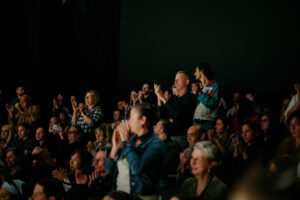
The showcase is also a moment of sharing. We watch performances together, discuss opportunities, eat together, and present the region as a cultural and artistic destination. This shared experience helps artists be recognised not only as individual voices, but as part of a vibrant and diverse movement.
How is a new generation of choreographers and dance professionals being developed through activities such as the summer programme at Centrul Național al Dansului București and the international mentorships?
We do not create choreographies – we create an environment. Through workshops and mentorship, we provide young professionals with access to experienced mentors, best practices, and knowledge – from the first steps of an idea to the creation of a full performance.
In Bucharest, for example, we organised a week-long programme for young choreographers that went through all key stages of the creative process. In Skopje, we held a workshop for dancers, and in 2026 we will host a workshop for arts managers in Sofia, led by internationally established professionals. In this way, the new generation gains not only skills, but also confidence, continuity, and a clear pathway into the professional field.
What potential do you see in the practice of “slow touring” as a tool for decentralising contemporary dance and building deeper connections between Balkan artists and local communities beyond major cultural centres?
“Slow touring” is not just about travel – it is about building relationships. When artists spend time within a community, they connect with the local scene, culture, and people. This is how joint projects, co-productions, and long-term partnerships emerge.
This model also offers a greener approach by reducing the carbon footprint associated with frequent travel. Moving Balkans encourages co-producing residencies in which artists from different Balkan countries create together, present the outcome, and leave behind a lasting cultural legacy.

How does Moving Balkans position itself within the broader European context—not only as a regional example, but also as a driver of innovation in contemporary dance?
As I mentioned at the beginning of our conversation, in 2022 the absence of Balkan artists at Tanzmesse nrw in Düsseldorf was painfully evident. Just two years later, thanks to Moving Balkans, we were able to participate in the world’s largest dance trade fair and not just anywhere, but at the most central stand, Stand No. 1. This represents a symbolic, but also very tangible leap forward for the region.
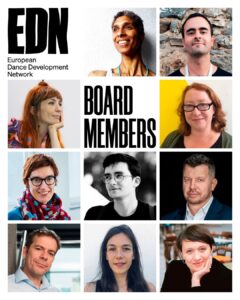
Moving Balkans is not a closed project; it actively collaborates with major European institutes and networks. Among our associate partners are the Goethe-Institut, the Institut français, EDN – European Dance Development Network, IceHot, and MASDANZA. Through these partnerships, we gain access to expertise, international stages, and participation in prestigious forums. This positions us not only as a regional platform, but as an innovator within the European dance landscape.
Particularly significant is the fact that in 2026, Balkan dance organisations will be in focus within the framework of the Canal project, organised by the Institut français and the Centre national de la danse (CND) in France. This will open up a new opportunity for artists from the region to present their diversity and to be seen by leading European professionals on one of the most prestigious contemporary dance platforms.
In this way, Moving Balkans positions itself not only as a regional platform, but as a driving force for innovation, actively weaving Balkan dance into the European cultural map.

What have you learned so far about the ability of art to overcome boundaries – political, institutional, or aesthetic?
We have become convinced that the unique language of dance is one of the most effective pathways for cultural diplomacy. Within Moving Balkans, organisations from countries with tense political relations work side by side as partners and friends, demonstrating how political boundaries can give way to shared artistic creation. Examples include collaborations between teams from Kosovo and Serbia, as well as Bulgaria and North Macedonia.
Partnerships with European cultural institutions such as the Goethe-Institut, the Institut français, and the EDN platform help dismantle institutional barriers, while the showcase and mentorship programmes expand aesthetic horizons through experimentation, exchange, and collaborative creative processes. Most importantly, the platform places the collective cause above individual ego, which makes these boundaries genuinely surmountable.
What comes next for Moving Balkans after the end of the project, scheduled for late 2026? A platform, a movement, or a new institution?
The project has already generated significant assets: partnerships, a network, artists, and audiences. The goal is for Moving Balkans to evolve into a sustainable platform that continues its mission beyond the end of the first project cycle.
We are planning a new application under the Creative Europe programme and further development of what has already been initiated. We believe that Moving Balkans will remain a lasting movement and support structure for Balkan contemporary dance, showcasing its diversity and ongoing development across Europe and internationally.
What challenges does a coordinator of European co-funded projects face?
A coordinator must simultaneously act as a leader, mediator, and diplomat. With 11 core partners (unofficially even 12), plus associate organisations, the greatest challenge lies in maintaining dialogue, motivation, and trust.
The coordinator is the public face of the project and bears responsibility both towards the consortium and towards European institutions. This entails constant communication, building a positive public image, and actively seeking new partnerships. It is demanding, but also deeply inspiring—because when the project’s mission aligns with personal and organisational values, the effort gains meaning far beyond administrative frameworks.
The “Moving Balkans” project is co-funded under the “Creative Europe” program of the European Union and the National Culture Fund of Bulgaria.