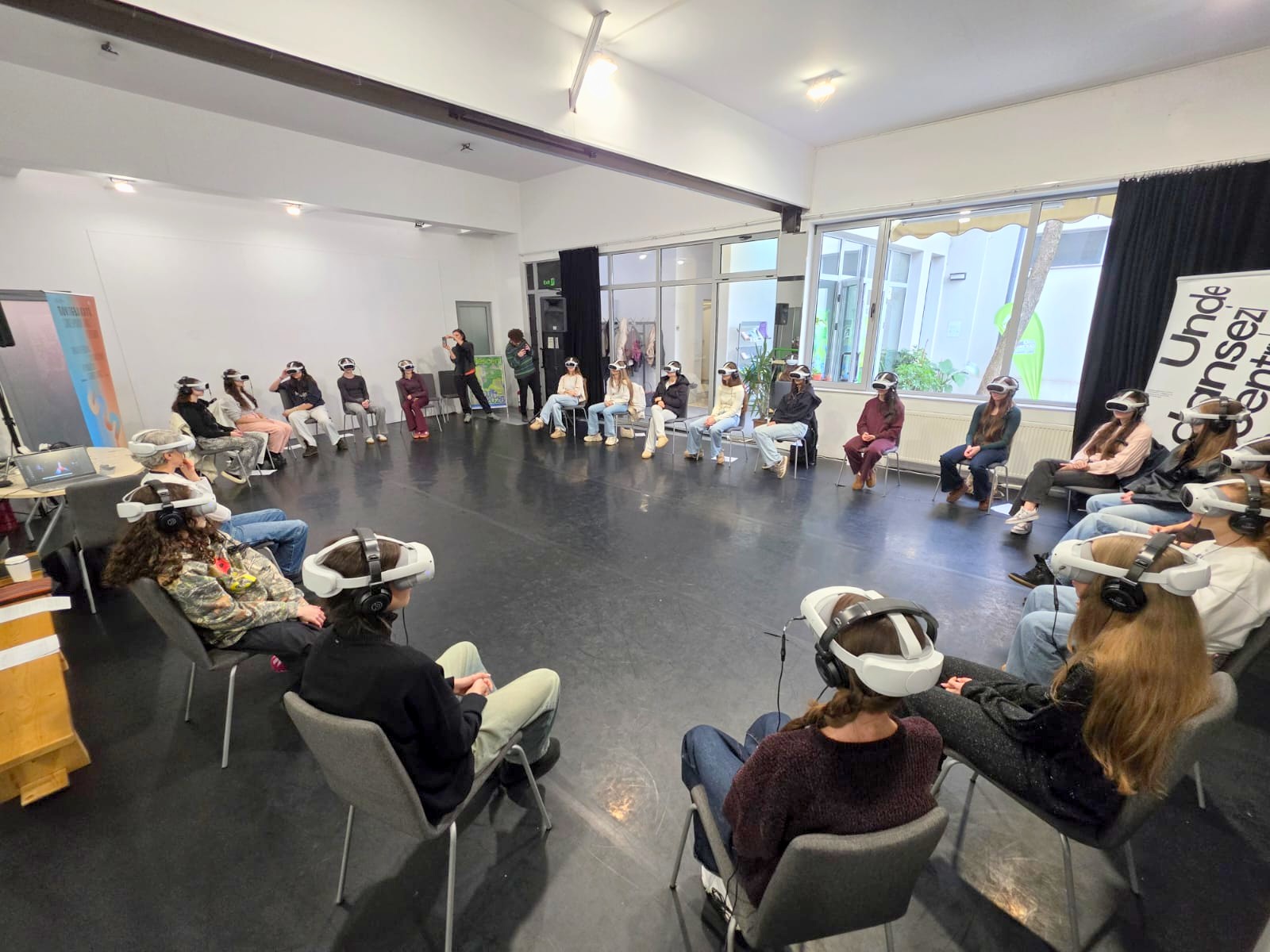
23 November 2026 | National Center for Dance Bucharest (CNDB) | Moving Balkans VR Green Touring
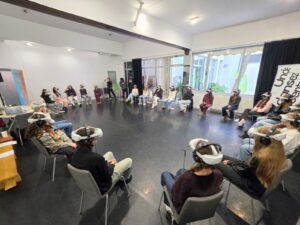
On 23 November 2026, at the National Center for Dance Bucharest (CNDB), dance students from the Conservatory and pupils from the Dance Academy watched two performances digitised in virtual reality. These were Telos by Ermira Goro and Unfolded Moments by Enya Belak and Kristýna Peldová.
The screening is part of VR Green Touring, the pilot programme of the European project Moving Balkans for digitising dance performances and touring them in virtual reality. The performances are chosen from the top 10 selection of the regional platform. The screening was hosted by Atanas Maev, manager of Derida Dance Center.
Two performances, two formats
Telos brings together several solos created for Ermira Goro by Maria Hassabi, Hannes Langolf, Ioanna Paraskevopoulou and Goro herself, a long-time performer with DV8 Physical Theatre. Unfolded Moments is a hybrid dance and visual performance about inner shadows, fears and identity. Both titles were among the 10 productions selected for the Moving Balkans Showcase 2026 in Novi Sad.
360°
Telos
The viewer is literally on stage and experiences everything from much closer. Recorded by EN-KNAP (Ljubljana, Slovenia).
180°
Unfolded Moments
The viewer watches as if from the middle of the front row. Recorded by the Croatian Cultural Centre Rijeka (HKD na Sušaku).
Both organisations are partners in Moving Balkans.
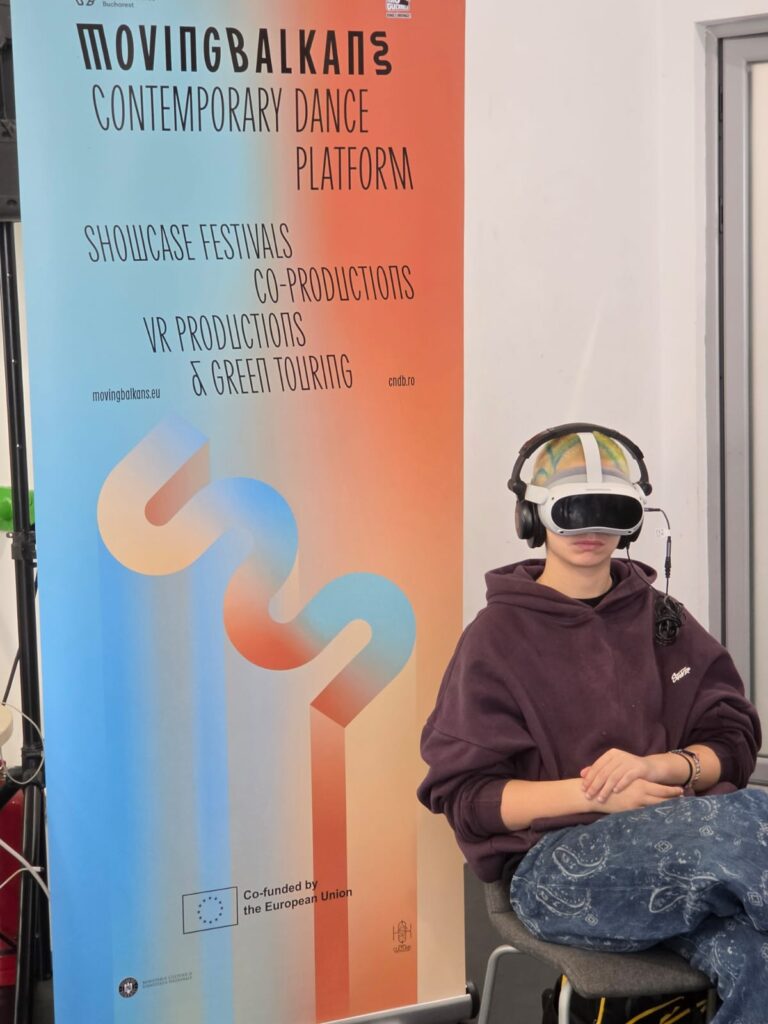
Details you cannot see from the audience
Telos was performed live on 6 November as part of Iridescent, the international contemporary dance festival at CNDB, which runs until 30 November. Several participants had already seen the performance in the theatre.
One of the students said that in virtual reality she was able to see many more small details. From her seat in the theatre, she had not noticed them.
The four directions of VR Green Touring
VR Green Touring is the part of Moving Balkans that is piloting work in four directions.
The first is archiving and digitisation. Many dance performances cannot be recreated after a few years, and a 2D recording is far from the experience of the live performance. Virtual reality turns out to be the closest thing to the live performance and even captures details that the live show cannot convey.
The second direction is access to culture. Dance reaches places that lack contemporary cultural infrastructure, as well as people with disabilities, older people and hospital patients who cannot go to the theatre. The third is reaching new audiences, because new technologies resonate much more with young people and teenagers. The fourth is reducing harmful emissions from long-distance travel.
Virtual tours bring other benefits too. Host organisations do not pay for travel, fees and technical equipment for a whole company, so small venues, schools and festivals with limited budgets can also present international productions. For dance students, the recordings are an educational tool for studying choreography up close and repeatedly.
For programmers and festivals, VR is a showcase. They can see a production almost as if it were live before inviting it. In this way virtual reality does not replace live touring but leads to it. Virtual tours also continue during pandemics, travel restrictions or visa barriers, and new professions such as VR directors, camera operators and technicians are growing around them, strengthening the dance sector in the region.
About Moving Balkans
Moving Balkans is a contemporary dance platform that brings together 11 organisations from the Balkans and runs from 2024 to 2027. The lead partner and coordinator of the project is Art Link Foundation / Derida Dance Center.
The project is co-funded by the European Union under the Creative Europe programme (project No. 101128452). The participation of Art Link Foundation is also co-funded by the National Culture Fund of Bulgaria.
The project partners are Albania Dance Meeting (Albania), Art Link Foundation / Derida Dance Center (Bulgaria), Contemporary Dance Association Slovenia (Slovenia), Croatian Cultural Center Rijeka (Croatia), Croatian Institute for Movement and Dance (Croatia), DAN.C.CE UNITIVA (Greece), EN-KNAP Productions (Slovenia), Interart Culture Center (North Macedonia), Kino Šiška Centre for Urban Culture (Slovenia), The National Center for Dance Bucharest (Romania) and Students’ Cultural Center Novi Sad (Serbia).


The project is co-funded by the European Union. Views and opinions expressed are however those of the author(s) only and do not necessarily reflect those of the European Union or the European Education and Culture Executive Agency (EACEA). Neither the European Union nor the granting authority can be held responsible for them.